Before you list: work out three prices, not one
Most sellers price from the product cost up. It is quicker, and safer, to work backwards from three numbers: the price where you stop losing money, the price that hits your margin, and the most you can pay for the product at the price the market will bear.
Key numbers
- $11.07break-even price for the example candle below — any lower and every order loses money.
- $17.78the price for a 25% margin, with the same costs.
- $12.78the most the candle can cost to make and still earn 25% at $26.00.
- $14.56break-even price when the order comes through an Etsy Offsite Ad (15%). Price below it and ad-attributed orders lose money.
The example: a candle sold on Etsy from the US
| Input | Amount |
|---|---|
| Item price | $26.00 |
| Shipping charged to the buyer | $6.50 |
| Product cost (wax, wick, jar, scent) | $7.40 |
| Inbound shipping per unit | $0.60 |
| Postage you pay | $6.10 |
| Packaging | $1.35 |
| Etsy fees | 6.5% transaction, 3% + $0.25 processing, $0.20 listing |
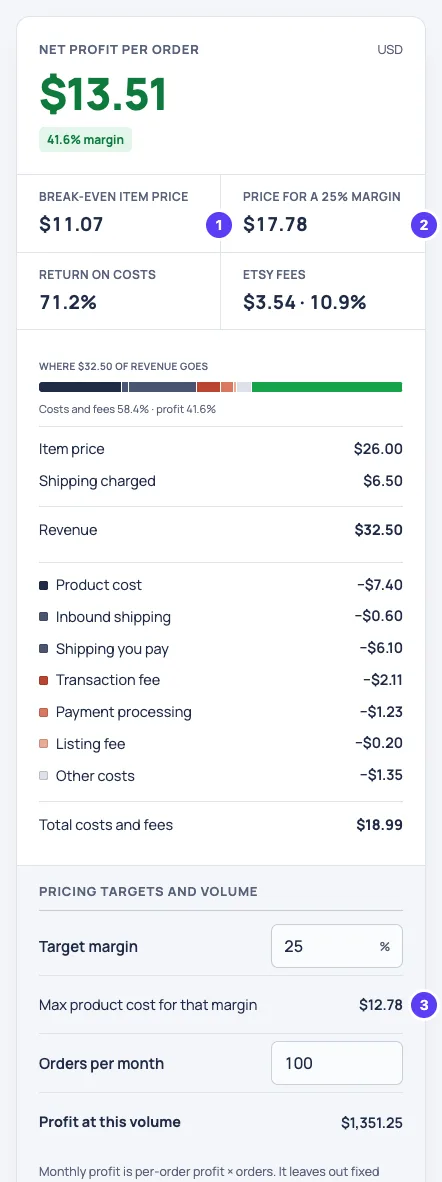
At $26.00 the order brings in $32.50 (item plus shipping), Etsy takes $3.54 and the candle earns $13.51, a 41.6% margin.
1. Break-even price: your floor
The break-even price is the item price at which profit is exactly zero. For this candle it is $11.07. It is the number to check before any discount: a 30% sale off $26.00 is $18.20, still above break-even.
2. Price for your target margin: your list price
Pick the margin you need after all fees — enough to pay for your time, returns and slow months — and solve for the price. At 25% the candle needs $17.78. Note that the answer is not cost × 1.33: percentage fees grow with the price, so the target price has to cover the fee on itself.
3. Max product cost: your ceiling for suppliers
If the market will only pay $26.00, turn the question around: what is the most the product can cost and still earn 25%? Here it is $12.78, against an actual cost of $7.40. That gap is your room to negotiate — or the amount a supplier price rise can eat before the margin slips.
The order you don’t control: Offsite Ads
When an Etsy order is attributed to an Offsite Ad, Etsy adds a 15% fee (12% for shops with $10,000 or more in Etsy sales over the past 365 days), capped at $100. On this candle the same sale then earns $8.64 instead of $13.51, and break-even moves from $11.07 to $14.56. If your list price sits between those two numbers, ad-attributed orders lose money. It is easy to miss, and it takes one field in the calculator to check.
Where the cliff is the constraint: an Amazon T-shirt
On Amazon clothing, the target-margin price can land in a band that earns less than a lower one (see Amazon’s referral fee cliffs). A T-shirt with a $6.20 cost and an assumed $5.00 FBA fee (taken as the same at all three prices) earns $5.88 at $20.00, $5.30 at $20.99 and $6.13 at $21.99. The calculator’s price search skips the bands where a higher price earns less, so its “price for a target margin” never lands in one.
How to run your own numbers
- Open the calculator for your channel: Etsy, Amazon FBA, eBay, imported goods, or the general margin calculator.
- Replace the example with your price, costs and postage. The result card shows profit, margin, break-even price and the price for your target margin; set the target under “Pricing targets and volume”, which also gives the max product cost.
- Use Compare two versions (step-by-step screenshots in How to use Selnook): keep your current numbers as A, change one thing — a supplier quote, a price, Offsite Ads at 15% — keep it as B, and read the difference line by line.
- Check the price ladder (“What other prices would earn”) before you settle on a charm price.
Everything runs in your browser; nothing you type is uploaded.
Sources
- Etsy Help, What are the Fees and Taxes for Selling on Etsy? ↗
- Etsy Help, What are Payment Processing Fees for Selling on Etsy? ↗
- Amazon, Selling on Amazon pricing: referral fees ↗
Fee pages checked on 28 October 2026. Fees change; the calculators link to the same pages so you can re-check before you price.